Pages

Thursday, January 15, 2015

Larry Ferlazzo's Websites of the Day... - 4 new articles

Your email updates, powered by FeedBlitz

Click here to read this mailing online.

Here are the latest updates for woowonenature@gmail.com

  1. Web 2.0 Tools For Beginning English Language Learners – “Padlet”
  2. “What Are Your Suggestions For Effective Classroom Management?”
  3. “Google Translate” Starts A Big Time Update Today
  4. Study Finds That Bilingualism Supports A Growth Mindset
  5. More Recent Articles
  6. Search Larry Ferlazzo's Websites of the Day...
  7. Prior Mailing Archive

Web 2.0 Tools For Beginning English Language Learners – “Padlet”

This post is the second post (the first one was Web 2.0 Tools For Beginning English Language Learners – "Phrase.It") in a lengthy series where I will be sharing the Web 2.0 tools that I'm using with my Beginning English Language Learners, along with explaining how we're using and sharing student examples of each one.

Padlet (formerly known as WallWisher), lets you create a sort of online bulletin board and easily add images or videos from the web, along with text. It’s one of many similar tools out there (see The Best Online Virtual "Corkboards" (or "Bulletin Boards") ), and is the “granddaddy” of them all.  It is also the easiest to use.

You might remember in my previous post a few days ago students created “speech/thought bubbles” on images related to food (that’s the theme we’re studying now).

After they each created five of them and posted the url addresses of their creations, students then left comments about what they liked about their classmates’ images. You can see those comments and links to their creations here.

Next, Alma Avalos, an extraordinarily talented bilingual aide, then created this chart:

foodchart

In keeping with our strong emphasis on inductive teaching and learning, we had students then list every kind of food each student wrote about in their speech bubbles. Then, they categorized them on a piece of paper.

That led us to the next step — creating a “Picture Data Set” (which you can read more about at The Best Ways To Use Photos In Lessons). Picture data sets are just adding the higher-ordering-thinking ability of categorization to the visual domain.

Students went to Padlet, which requires no registration, and grabbed images off the web of each food item their classmates had chosen earlier. They then added a text description to each image and categorized them. You can easily embed a Padlet Board, but since they’re still working on them, I decided to show a screenshot instead:

padlet

The final step in an inductive learning task like this is “expansion,” so students will find and add new items to each category.

Obviously, a similar project can be done with papers, pencils and pictures cut-out of magazines (or student drawings) — and I’ve done it that way in the past. However, one of the major reasons I’m being so intentional these days with Web tools is because I want students to be creators as well as consumers of online content when we’re in the computer lab, and I want them to feel comfortable doing so with minimal instruction from me.  As usual, my multi-level and multi-grade class is growing with new students at this time of the year, and a higher-order thinking task like this is an easy one students can do in each thematic unit we study.

If you have other suggestions on how to enhance this activity, I’m all ears!



Sponsor message
powered byad choices

“What Are Your Suggestions For Effective Classroom Management?”

What Are Your Suggestions For Effective Classroom Management? is the latest “question-of-the-week” at my Education Week Teacher column.

Feel free to leave your responses in the comments there or here…

What-are-your11111


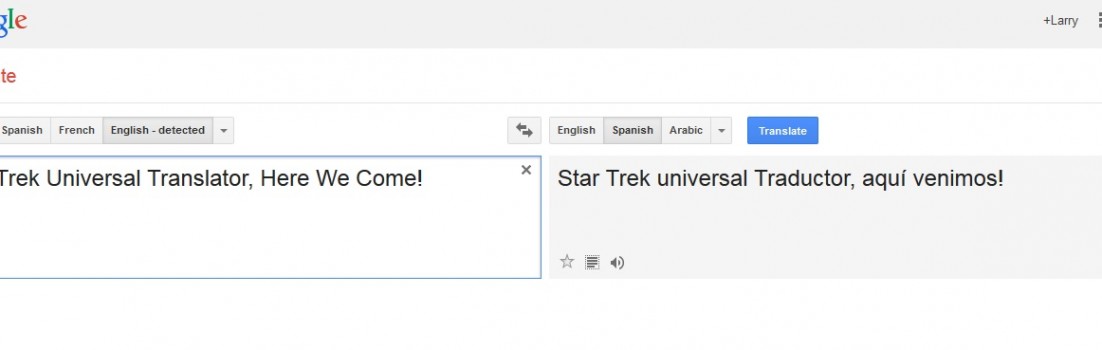
“Google Translate” Starts A Big Time Update Today

googletranslate

A few days ago I posted about an exciting upcoming update to Google Translate that would provide simultaneous verbal translation.

They begin rolling it out today. In addition, the update will also enable translation of images.

Here’s how The New York Times explains it:

In this version, the app is supposed to pick up who is talking based on the language being spoken. So, say you wanted to order a slice of chicken pizza in Spanish. Using the app, you could walk into a pizza parlor, and, with your lips at an awkward proximity to the phone's microphone, make your request, after which a robotic voice would spit out the question in Spanish.

Then let's say the guy behind the counter asks if you want extra cheese. He could ask you that question in Spanish, and the phone would relay it in English. Respond "Yes" or "No" in English, and out comes Spanish again.

You can also read more about it at TechCrunch’s post, Google Translate Now Does Real-Time Voice And Sign Translations On Mobile.

I’m looking forward to trying it out. It could be a big help for teacher of English Language Learners who receive very early Beginners in their classes, and for some limited teacher/parent communication.

I’m adding this post to The Best Sites For Learning About Google Translate & Other Forms Of Machine Translation.


Sponsor message
powered byad choices

Study Finds That Bilingualism Supports A Growth Mindset

Bilingualism changes children’s beliefs is the headline of an article in Science Daily about a new study that I think is very, very interesting — and it makes sense.

The study basically found that learning another language promotes the belief that more things can be learned and fewer abilities are innate — a key tenet of a growth mindset.

Here’s an excerpt:

The-study-forthcoming-in

I’m adding it to The Best Resources On Helping Our Students Develop A "Growth Mindset" and to The Best Resources For Learning The Advantages To Being Bilingual Or Multilingual.


Sponsor message
powered byad choices

More Recent Articles


Sponsor message
powered byad choices


Email subscriptions powered by FeedBlitz, LLC, 365 Boston Post Rd, Suite 123, Sudbury, MA 01776, USA.

No comments:

Post a Comment