I know that I haven't reached expert status yet when it comes to photography, but I do believe that I'm making steady progress in that direction. I've also attempted to pass on what I've been learning, it seems so simple when you hear a true expert tell you how he or she was able to capture such great photos as they are displayed in the videos that I've been watching. I'd like to continue passing on tips or other things that I learn, but I'm finding that what works for one person may not work for another. Some of that is gear related, not every one uses the same camera(s) and lens(es) as I do.
Here's an example of what I'm learning, you may remember that I wrote at length about the difficulty that I had getting a good, sharp focus when using the 300 mm L series lens on my 60D bodies, with one of the bodies being slightly better with that lens than the other. No need for me to repeat all of that now. Since then, I purchased the 7D Mk II camera, and all those focusing problems have gone away, the 300 mm lens performs like a champ on that body. I had similar, but less severe problems with the 70-200 mm L series lens as well.
Continuing that theme, how I get a good, sharp focus with the 7D body is completely different from how I do it with either of the 60D bodies, no matter which lens I'm using. There are even slight differences between the two 60D bodies.
The lens that I own that needs the least help in getting great photos is the Beast (Sigma 150-500 mm lens) as far as my longer lenses. The wide-angle lenses perform well enough that I've noticed few problems with any of the bodies, but that may be due to the increased depth of field with them. I haven't tried the new Canon 100 mm macro lens on the 7D yet, but by looking at my photos with that lens on the 60D body, it performs very well when I use the same tricks to get a sharp focus with it as I do with the other L series lenses.
The same applies to every aspect of photography, different camera and lens combinations can change how I set exposures as another example.
So, the best advice that I can give any one is to learn their equipment, it may be that you haven't hit the right combination of doing what it takes to get really good photos from the gear that you're using.
I find that watching the online tutorials is helping me a great deal as well, not so much with technique as learning composition and other more creative aspects of photography, but you have to take things the presenters say with a grain of salt. Most are sponsored by a manufacturer of some type of gear, and they may shade the truth slightly from time to time in order to push you towards their sponsor's gear or make you believe that only the most expensive items will work well.
The other reason for what I believe to be major improvements to my images is having begun to use Lightroom, and as I said before, not so much for editing, although that helps, but by enabling me to see what the how image I'm looking at through the viewfinder will appear when I press the shutter release. Before I started using Lightroom, I went with what looked best to me as I saw it in the viewfinder at that moment, and I'm finding that it may not produce the best final image. For that, I may need to move slightly in one direction or another, or compose the shot differently by using different focus points available to me in the camera. Cameras see things slightly different from what our eyes do, at least my eyes, so I'm learning to see what the camera sees, and not to try to force the camera to record exactly what I see, which the camera may not be able to do.
I watched several videos where Nat Geo photographer Michael Melford discussed some of his best photos, and one of the tips he offered to improve your photography is to study artwork of the great painters to learn how to use the light, and for composition. I would say that studying the works of great photographers is much the same. The nice thing about the videos from B&H that Michael Melford did is that he often included his first image of a scene or subject, then he explains what he did to get to the image that was finally published. I could attempt to repeat what he said, but here's the link to the video if you're interested.
Well, I think that it's about time to get to some photos. I'm certainly not another Michael Melford, but I'm going to do a series of photos to show what can happen if you're patient, and not willing to settle. I had photographed these day lilys before, they are near the picnic shelter at the park that I walk in around home, and the shelter makes a nice place to take a break. It was cloudy when I got there, so I broke out my flash unit for this one, just for practice.

Day lily
A few minutes later, the sun broke through the clouds for this one.

Day lily
And then, a miracle of sorts happened, the sun was lined up just right to shine straight down into the lilys!

Day lily

Day lily

Day lily
As you can see, I tried several different views and flowers before I got that last one, which is my favorite of the lot.
On an earlier day, I happened into some great lighting as the sun broke through the clouds to illuminate the leftover low fog that had formed overnight.

Sun on fog
Sadly, I blew it on that day, I was running around like a madman looking for something to shoot in the magical light of that moment. Some of these are okay, but some of them I'm not very happy with, even though I converted a few to black and white.

Boneset in the sun

Boneset in the sun 2

Boneset in the sun 3

Thistle seeds in the sun

spider web in the sun

spider web in the sun

spider web in the shade

Queen Anne's lace in the sun

Queen Anne's lace in the sun

Abstract 1

Abstract 2

Artsy chicory
I know that I've said this before, but I'm much better at photographing wildlife. So much so, that while I was in the middle of shooting those, I let myself get distracted by shooting these.

Female American goldfinch

Female American goldfinch

Female American goldfinch
I just can't help myself, when I see a bird that close to me, I just have to shoot it. Here are a few others from later that same day.

Male northern cardinal

Grey catbird, do they always sit where they have a shadow across them?

Northern flicker

Northern flicker
And, here's how squirrels eat mulberries, first they sniff them...

Fox squirrel sniffing mulberries
...then they taste test them...

Fox squirrel tasting a mulberry
...and if it tastes good, they wolf the berries down as quickly as they can.

Fox squirrel eating mulberries

Fox squirrel eating mulberries

Fox squirrel eating mulberries

Fox squirrel eating mulberries
Finally, they pose to make sure that their photo appears here in my blog.

Fox squirrel posing for the camera
On the other hand, red squirrels prefer to dine without a camera sticking in their face.

Red squirrel eating mulberries

Red squirrel eating mulberries
While I'm at it, I may as well include the rest of the photos that I shot that day and saved to post in my blog.

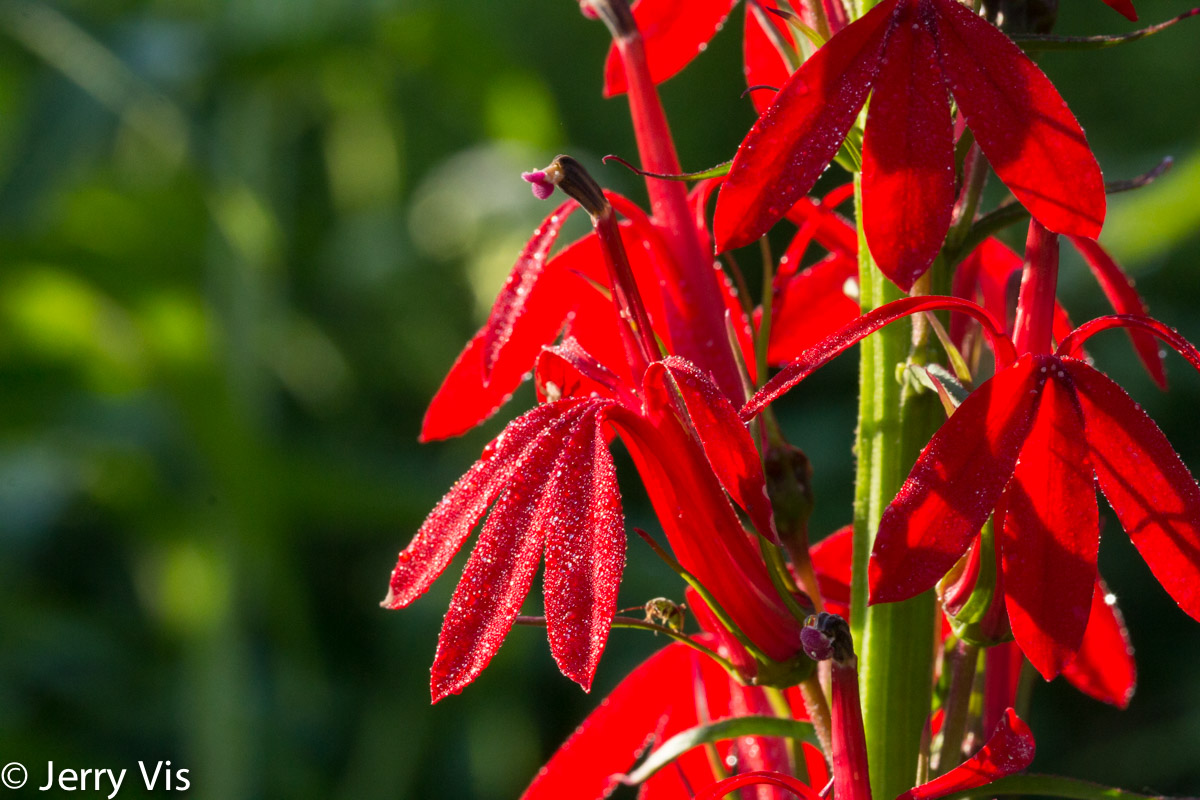
Cardinal flower

Cardinal flower

Cottontail rabbit

Spotted knapweed

First signs of fall's approach

Great lobelia

Bee balm

Caterpillar
I have this problem, most of the time, the latest photos that I've shot are my favorites. There are exceptions, yesterday I went to Muskegon, and while I came home with quite a few photos, none of them really struck me as very good. On the other hand, I went out today, and brought back more good images than I thought that I would. But, you'll have to wait to see how well the new Canon 7D Mk II can track a flying hummingbird until I used up some of my earlier photos. ;)
That's it for this one, thanks for stopping by!




 WordPress.com

No comments:
Post a Comment